
Topics
A topic is a long-lived conversation that keeps its own history and context. Where a chat is throwaway, a topic is a thread of work you return to over days or weeks — and it can be linked to a GitHub issue whose body, comments, and labels become live context on every turn.
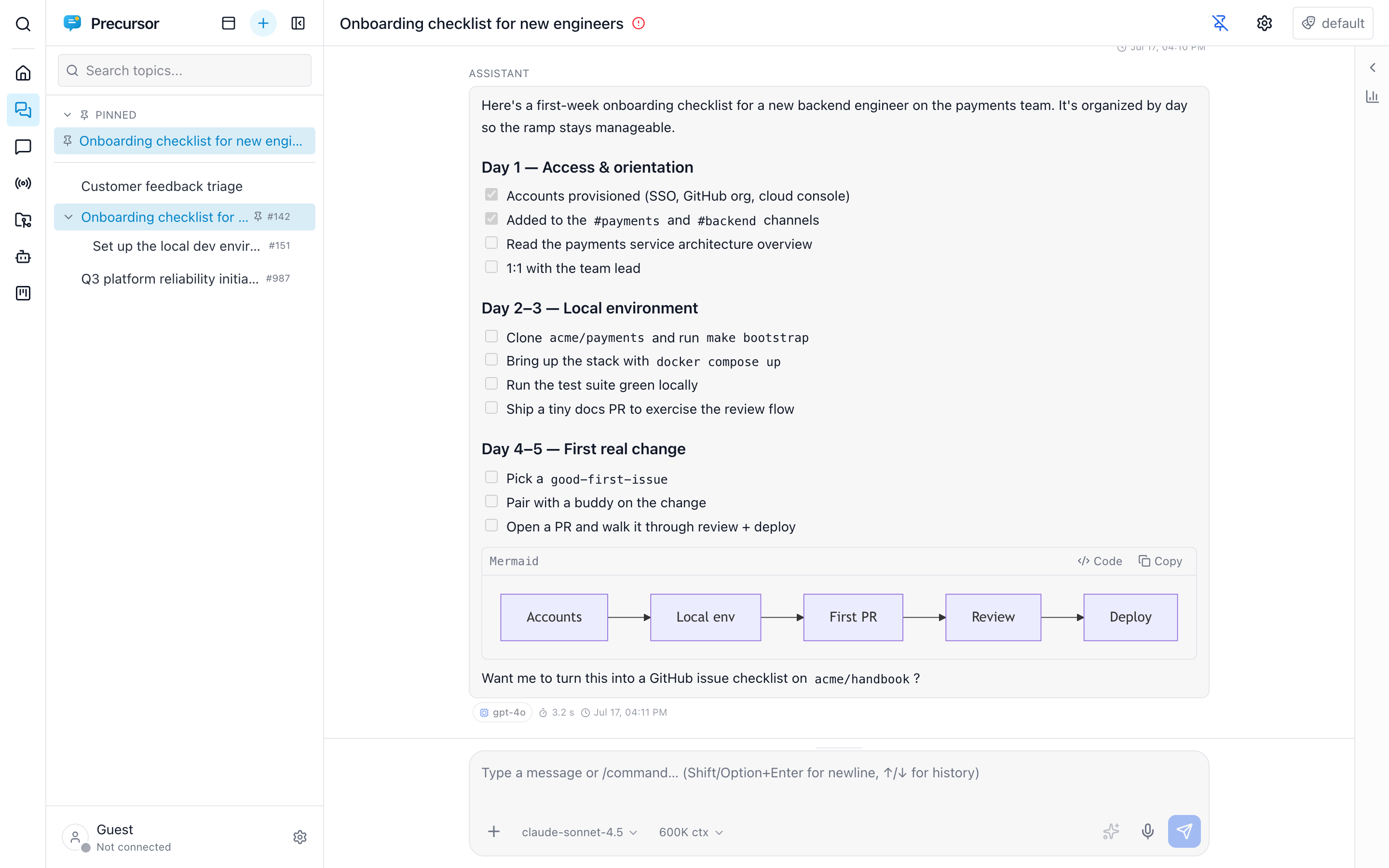
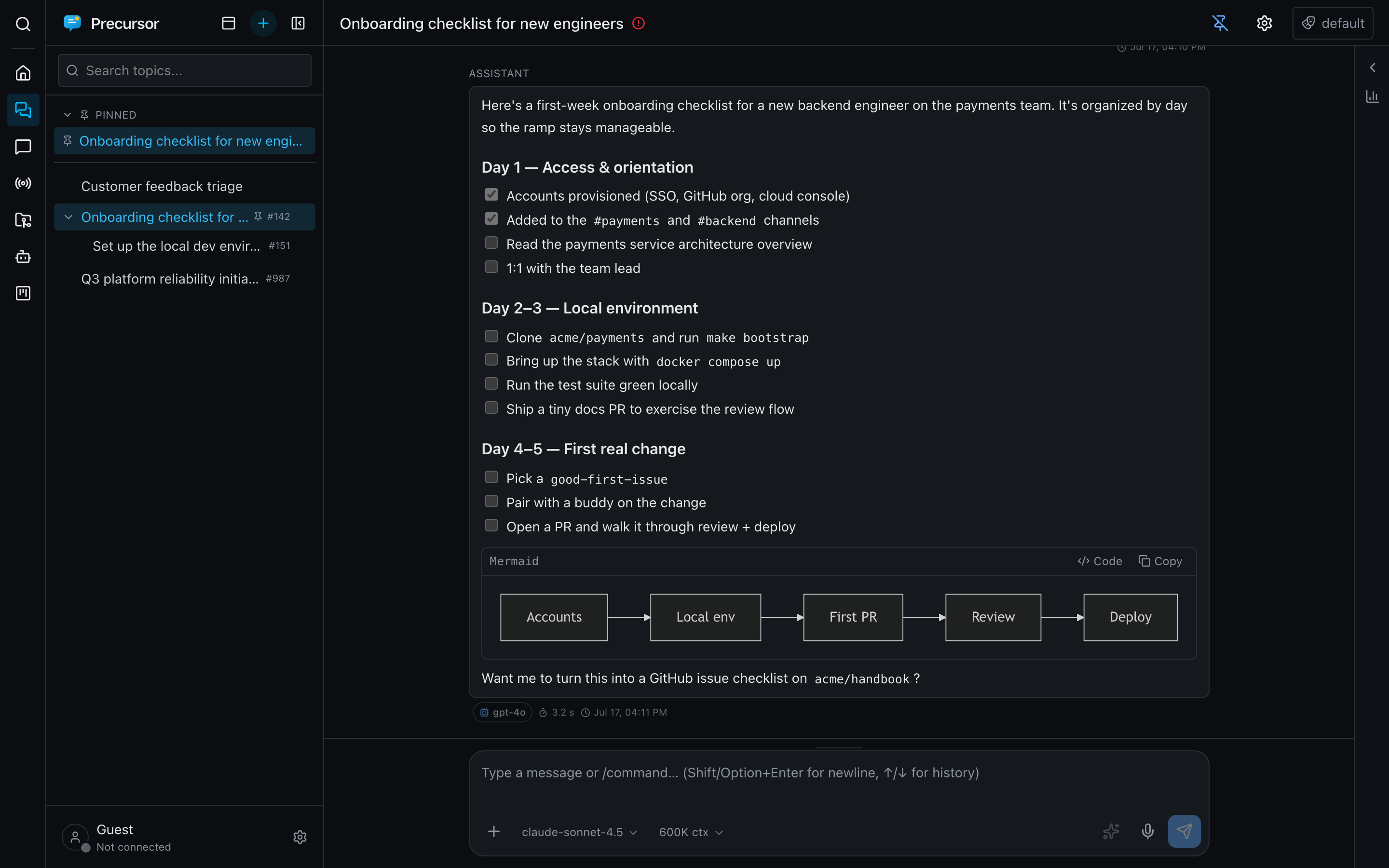
Issue-linked context
Link a topic to a GitHub issue — paste a URL or number, or create a new issue from the topic. Every turn then rebuilds the assistant's context from the issue's body, its most-recent comments (newer outweigh older), and its labels, which also tag the chat.
Because that happens on every turn, edits to the issue propagate immediately — the assistant always reasons over the current state of the work.
Precursor writes back too: create or update the issue, and post comments, from the composer's GitHub actions and the shared draft panel.
Tree organization
Topics form a tree — nest one under a parent to group related threads. Right-click any topic in the sidebar to act on it without opening it: rename, pin, set a reminder, move it to another collection, or archive.
Not sure what to call one? /suggest-name reads the conversation so far and renames the topic for you — the same naming pass that names new chats.
Over MCP, a topic's place in that tree comes back already resolved as a path — the collection slug followed by the ancestor chain (client-a/csu/capacity-review) — so an agent never has to walk parent_id upward. It mirrors the URL exactly, so a path can be pasted into the browser.
Above the tree, collections split your topics into separate workspaces and filter the sidebar to one at a time.
Addressing a topic
Every topic has two addresses.
The readable one describes where the topic sits — its collection, then the ancestor chain, then its own slug:
/topics/client-a/csu/cto/capacity-reviewIt's the URL the address bar shows, and it's meant to be legible. That also means it moves: rename the topic, drag it under a different parent, or send it to another collection and the readable URL changes with it.
The permalink never moves:
/t/6f2b1c9e-6b1a-4a0e-9f0f-2f5b0f9f1c2aIt's an immutable UUID minted when the topic is created. Opening it resolves the topic and rewrites the address bar to the readable URL, so you land in the right place with a legible address. Copy it from topic settings → Permalink — it's the address to paste into an issue, a commit message, or a bookmark that has to survive reorganising.
Old links keep working
Links minted before collections joined the URL (/topics/csu/capacity-review) still resolve: the trailing slug is unique on its own, and Precursor rewrites the address to the current readable form once it has loaded.
Scheduling & reminders
Any topic can carry a schedule so a prompt runs on a cadence, or a one-shot reminder that resurfaces the thread at a set time. See the scheduler.
Under the composer
- Streaming replies with markdown, mermaid, and code highlighting.
/slash commands — skills, memory, GitHub actions,/notes.- Attachments — images (vision) and documents.
- MCP tools — shown inline as they are called.
When a turn fails
A failed turn — a rejected model, bad credentials, a tool loop that hits its cap — is persisted as a red error notice, never a green acknowledgement, and it survives a reload. The prompt that failed grows a Retry button that replays it against the current model and settings, dropping the failed tail. Fix the cause first (switch model, add a token in Settings → Models) and the retry picks it up.