
Import & export
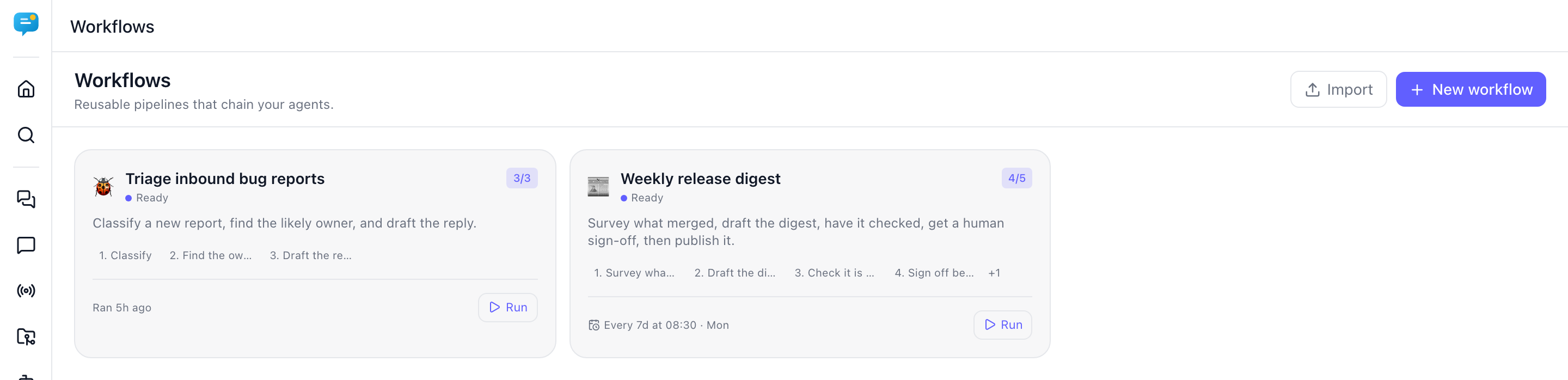
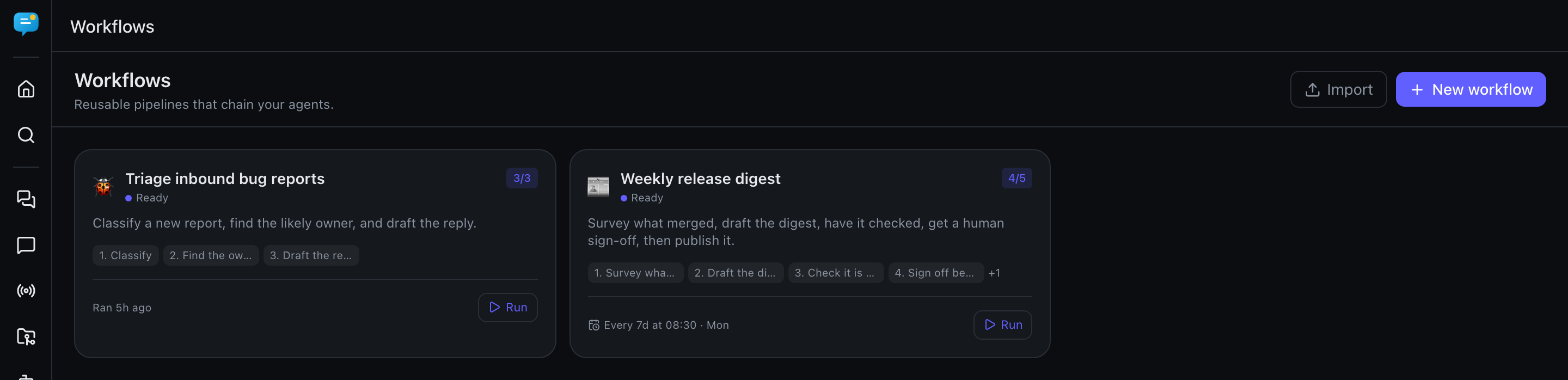
Agents and workflows are definitions, not just live objects — so they can leave the app. Export writes one to a plain YAML file you can read, diff, commit next to the project it automates, or hand to a colleague; import brings one back, asking what to do about anything that already exists here.
One object per file
An export is always a single top-level object: one agent, or one workflow. A workflow file still carries the agents its steps reference — a pipeline that arrives without its agents isn't runnable — but those travel as dependencies, not as co-equal exports.
Exporting
- A workflow — the download icon in the detail board header.
- An agent — Export as YAML in the agent's settings drawer. Step-private agents can't be exported on their own; export the workflow that owns them.
Everything that describes what to run travels: the prompt and objective, the model, autonomy and step budget, the approval policy, token budget and retries, the capability toggles, the Assistant Role persona, and — for a workflow — its full step wiring, including gate loop-back targets, approval checkpoints and per-step instructions.
What deliberately doesn't
| Left out | Why |
|---|---|
| Status, run history, artifacts, token counters | A file describes what to run, never what happened. |
| The Copilot SDK session handle | A runtime resume handle for this install; it means nothing elsewhere. |
| Webhook tokens | They're per-install credentials. Sharing a file must never share a way to fire it. Re-mint on the target. |
| Topic / chat links | Machine-local containers. An imported agent arrives unattached. |
Because the recurrence is part of the definition, a schedule travels — all of its rules, not just the first — but it arrives paused. A file dropped into a new install describes when something should run; it doesn't get to start running it.
Importing
Import sits next to New workflow in the Workflows gallery and next to New agent on the Agents dashboard. Drop a .yaml file and Precursor shows you what it would do before writing anything.
Resolving what already exists
The interesting case is a name that already exists here. That's a genuine fork in the road, so the preview asks per agent:
| Choice | What happens |
|---|---|
| Use existing | The imported step points at the agent you already have, left completely untouched. |
| Replace | The existing agent's definition is overwritten in place. It keeps its id, so every other workflow using it picks the new definition up. The preview warns you how many that is. |
| Create new | Both are kept: the file's agent is imported as a separate copy under a disambiguated name (Reviewer (2)). |
A workflow whose own name collides offers Replace or Create new — a workflow isn't a shared resource the way an agent is.
On first export an object is stamped with a stable portable id that travels in the file, so re-importing a file that originally came from this install recognises the very object it came from and defaults to Replace. A bare name match is a weaker signal, so it defaults to Use existing: a shared file must never silently overwrite someone's prompt. That default also governs scripted imports that send no choices, which are therefore always non-destructive.
Replace ripples
Agents are shared. Replacing one edits the definition every live workflow referencing it will use on its next run. The preview surfaces the count up front, but it's worth a second look when it's more than one.
A carried Role is matched by name and only created when genuinely new, so importing two workflows that share a persona converges on one role. Inline step agents are never conflict-checked — they belong to their step, so they're simply recreated with it. A pinned model this install doesn't offer is a warning rather than an error; the agent imports and falls back to the default.
API surface
| Method & path | Purpose |
|---|---|
GET /api/transfer/workflows/{id} | Download a workflow (+ its agents) as YAML |
GET /api/transfer/agents/{id} | Download an agent as YAML |
POST /api/transfer/preview | { "content": "<yaml>" } → conflicts + warnings. Writes nothing |
POST /api/transfer/import | { "content": "<yaml>", "resolutions": [...] } → applies it |
A resolution is { "kind": "agent" \| "workflow", "index": <n> \| null, "action": "replace" \| "create" \| "link" }, keyed exactly as the preview reported the conflict. Anything left unresolved falls back to the preview's safe default.
The file format
format: 1
kind: workflow
exported_by: Precursor 2026.1
agents:
  - export_id: 2f1c…            # stable portable identity
    title: Collector
    task: Gather this week's issues
    use_mcp: true
  - title: Review               # an inline step's private vessel
    task: Check the draft reads well
    inline: true
workflow:
  export_id: db19…
  name: Weekly digest
  max_loops: 3
  steps:
    - agent: 0                  # index into `agents`, never a local database id
      name: Collect
      kind: task
    - agent: 1
      kind: gate
      on_fail_position: 0
    - name: Publish?
      kind: approval
      on_reject: stop
Steps address agents by index within the file, because database ids are install-local — which also keeps the document readable and editable by hand. format is refused when it's newer than the running version, rather than silently dropping fields it doesn't understand.