
Workspaces & files
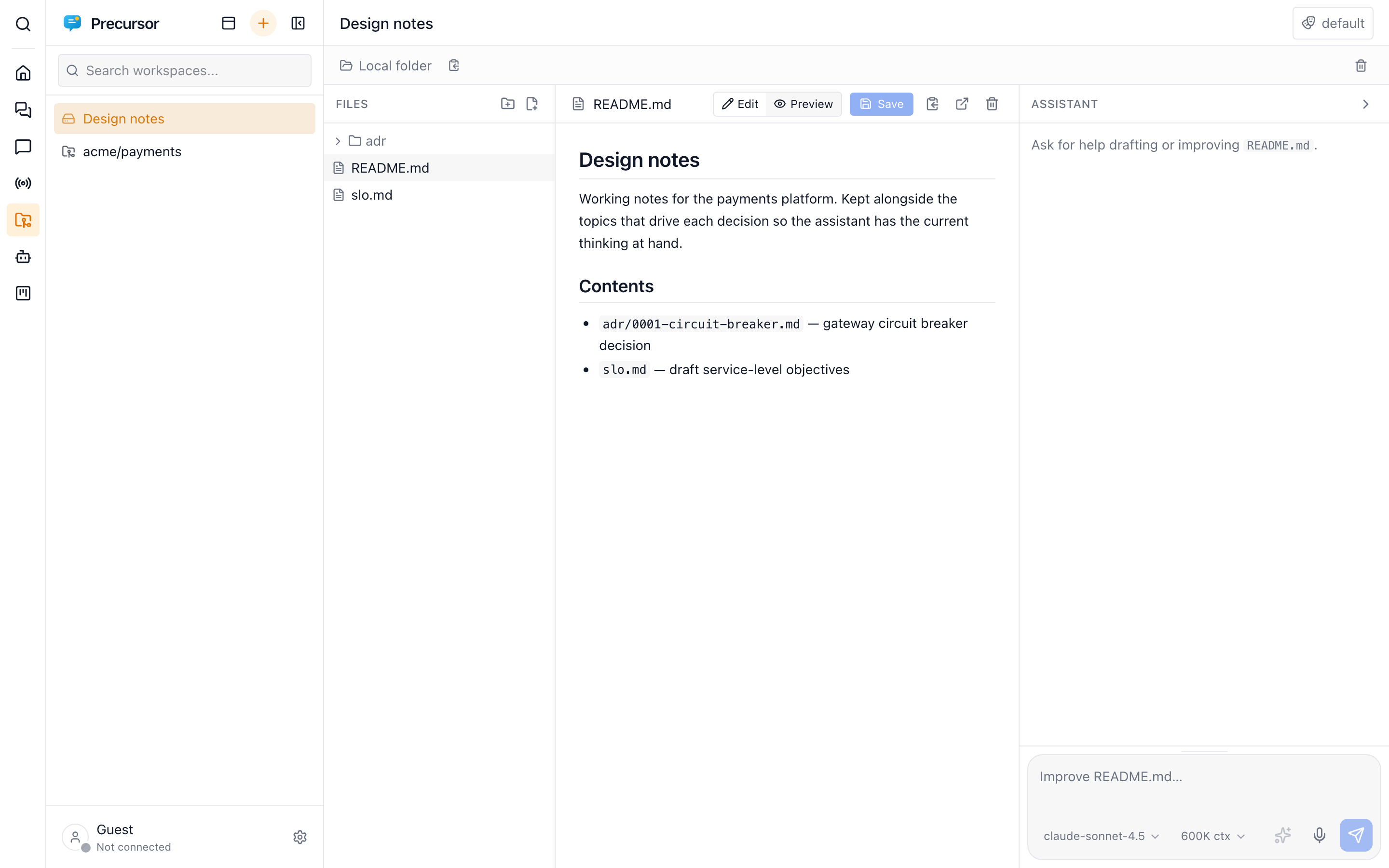
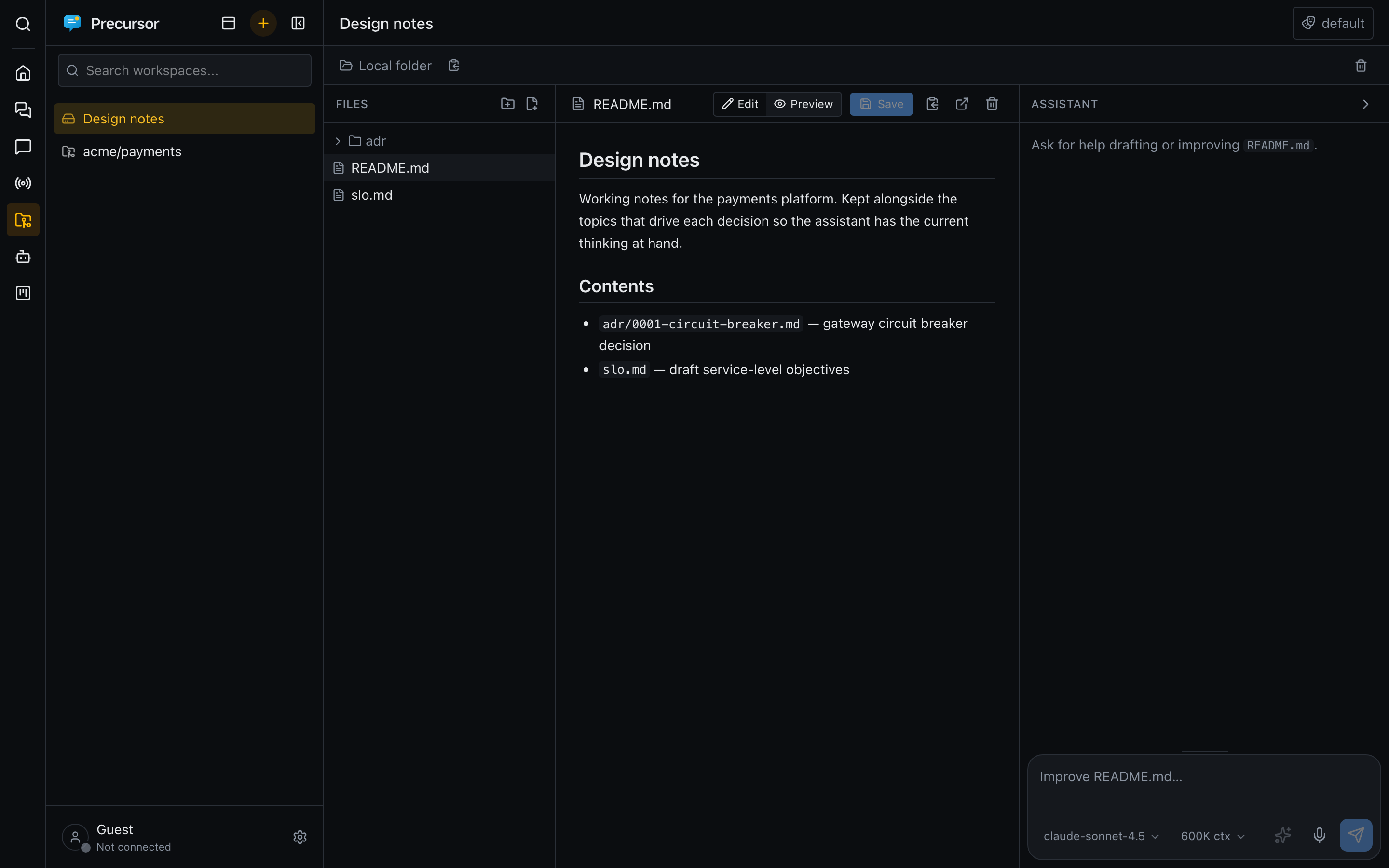
A workspace is a git clone or a plain folder that the assistant can browse and edit. The Files section lets you explore the workspaces backing your sessions, and the assistant operates on them through a sandboxed file layer.
Git repositories and local folders
New workspace offers two kinds:
- Git repository — Precursor clones it into a local working copy and can pull / commit, so changes are reviewable as a
git diff. Needsgiton the server; the token is injected at operation time and never stored on the workspace row. - Local folder — creates an empty folder for authoring files, with no git behind it. The same file tools apply.
The sandbox
Every file operation is routed through safe_join, which:
- rejects path traversal outside the workspace root, and
- blocks access to
.git.
The same sandbox backs the workspace-fs and drawioMCP servers, so when the assistant reads, edits or diagrams files during a turn, it stays inside the jail.
Working with files
From the Files section you can browse the tree, open files, and view git diffs for changes. Combined with the command runner and the workspace-fs MCP tools, this lets the assistant make and review changes to a repository as part of a conversation — while everything stays confined to the workspace root.
Markdown files get a rendered Preview, HTML files render in a sandboxed frame, and .drawio files open in a full diagram editor (below).
Jumping from a conversation to the file
When the assistant touches a file in a workspace during a chat or topic — a diagram via the drawio MCP server, or any file via workspace-fs — the tool call in the transcript carries an Open chip naming it. One click switches to the Files section with that file already open, so a diagram produced (or merely inspected) mid-conversation doesn't have to be hunted down in the tree. Browser Back returns to the discussion.
This covers reads as well as writes: read_diagram and read_file link to what they read, which is handy when the assistant quotes a fragment and you want the whole thing — or when the read was truncated.
A failed call, a folder, or a path that can't be turned into a safe route carries no link — so a chip never points somewhere unexpected.
Editing diagrams
A .drawio file — whether you drew it yourself or the assistant authored it with the drawio MCP server — opens in an embedded draw.io editor, with an XML / Diagram toggle to drop down to the raw mxGraph source. Edits stream back into the same buffer as any other file, so the usual dirty marker, Save, and git diff apply unchanged.
The editor is self-hosted: Precursor serves its own copy of the draw.io webapp at /drawio/, and the frame runs with offline=1&stealth=1, so diagram content never reaches diagrams.net or any other external origin — and editing keeps working with no network at all.
That copy is not bundled in the wheel (the release is ~53 MB, ~150 MB extracted). The first time you open a diagram, the Files pane offers a one-time install that downloads the pinned release into <data_dir>/drawio/<version>/. Set PRECURSOR_DRAWIO_VERSION to pin a different release, or PRECURSOR_DRAWIO_DOWNLOAD_URL to fetch it from an internal mirror — see configuration. Superseded versions are removed when a new one installs.
See the architecture reference for the data model.