
Live meeting assistant
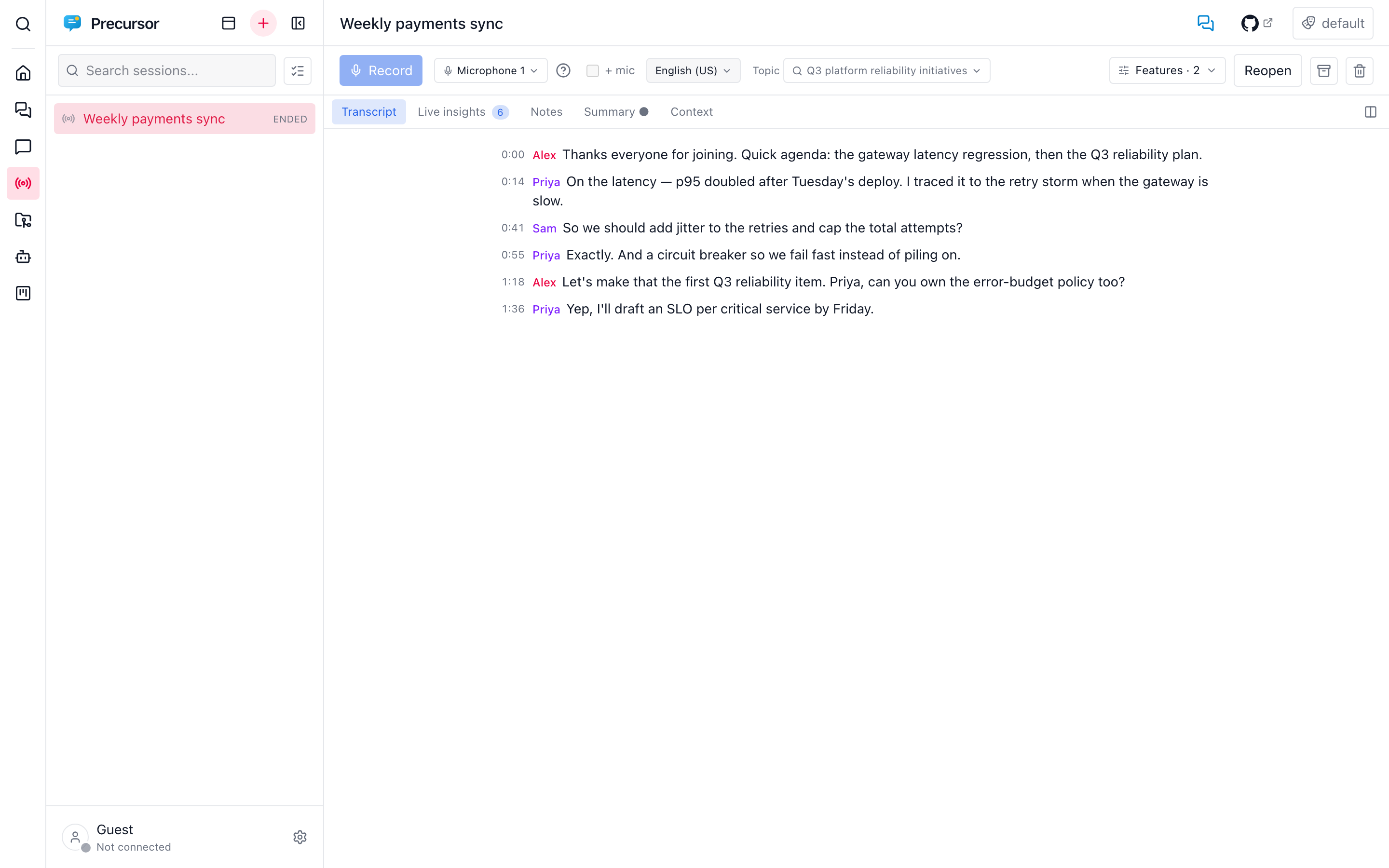
The Live section records an ongoing meeting, transcribes it with speaker labels, and surfaces live insights, Q&A, and an editable summary you can attach to a topic. Audio is transcribed in the browser via Azure Speech and never stored — only the transcript and derived insights are kept.
Prerequisites
Transcription uses Azure AI Speech. Set a Speech key and endpoint under Settings → Speech-to-text. Until then, sessions can be created but the Record button stays disabled.
Capturing meeting audio
A browser can only capture audio it's given access to. For an in-person meeting, selecting your microphone is enough. For a remote meeting in a desktop app (like Teams), you route the app's output through a virtual audio device that then looks like a normal microphone to the browser — while still sending the audio to your speakers so you keep hearing the call.
The How to capture meeting audio dialog (the ? next to the input picker) has step-by-step, OS-specific instructions:
- macOS — BlackHole + a Multi-Output Device.
- Windows — VB-CABLE with Listen to this device enabled.
- Linux — a PipeWire / PulseAudio null sink + loopback.
For hybrid meetings, tick + mic to also capture your local microphone alongside the virtual device — both streams are mixed and transcribed together.
Starting and protecting a recording
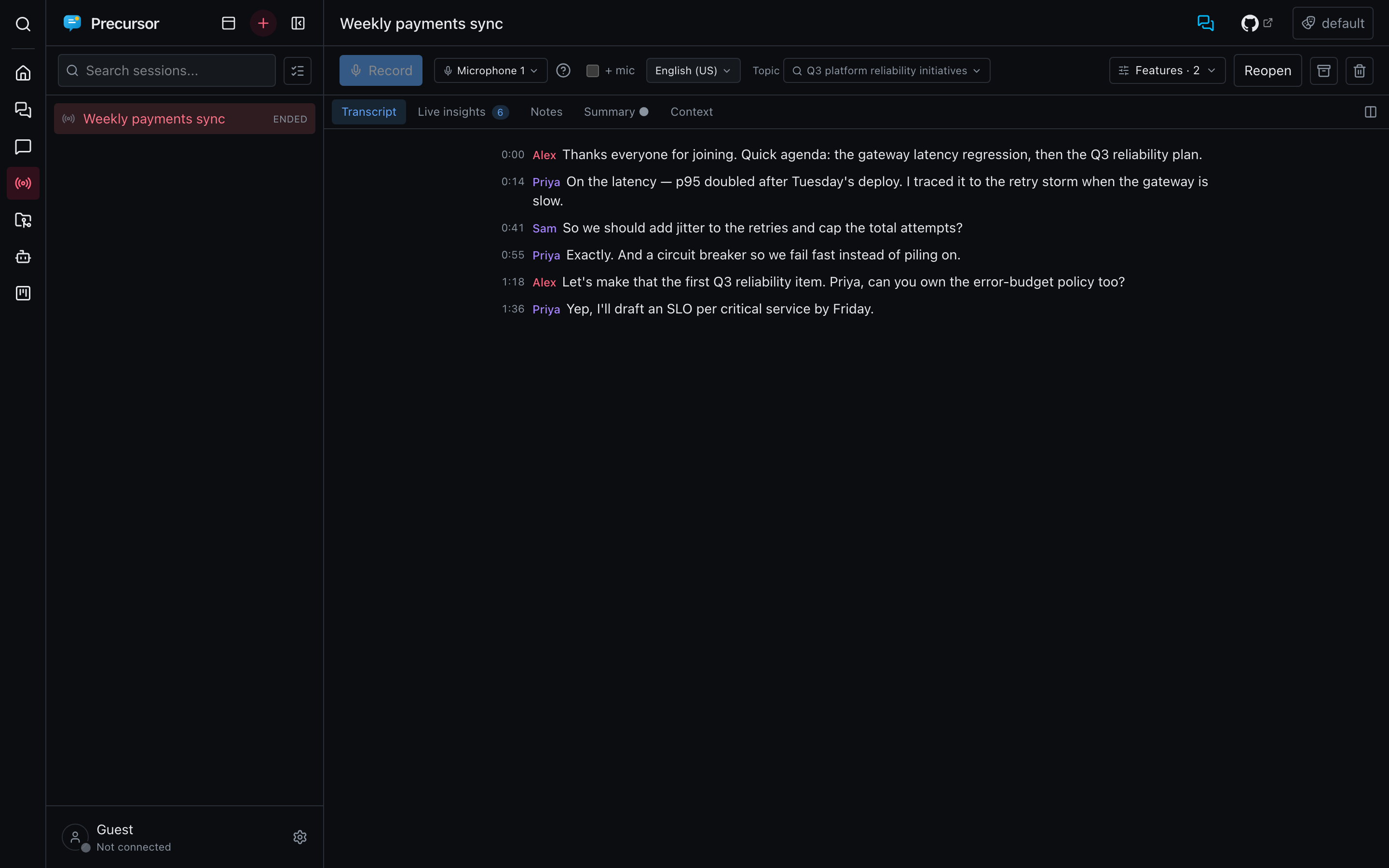
The record controls — Record, the capture-device picker, + mic, and the meeting language — are pinned at the top of the Transcript tab, so they stay in reach as the transcript grows.
While a recording is live, Precursor guards against losing it by accident. Leaving the screen in-app asks you to confirm first (Keep recording or Leave & stop recording), and reloading or closing the tab triggers the browser's native "leave site?" prompt.
Language
Pick the meeting language when creating the session or from the record controls. Changing it mid-session briefly restarts the recognizer, since Azure can't switch a running recognizer's language in place. Live insights and Q&A answers are produced in the session's language.
Insights, Q&A, and summary
The Live view is a tabbed, splittable panel — Transcript · Live Insights · Summary · Context. Use the Split toggle to view two sections side by side.
- Live Insights — while recording, the assistant re-derives a snapshot of action items, decisions, open questions, suggestions, and risks from the rolling transcript.
- Ask assistant — ask free-form questions; answers stream from the transcript plus the attached topic.
- Speaker labels — click a label in the transcript to rename it (
Guest-2→Thomas); the name applies to every past and future phrase from that voice. - Fix mistaken words — double-click any phrase to edit its text in place, handy for correcting a misheard word before it feeds the insights and summary.
- Summary — an editable markdown recap, including an Attendees list (seeded from renamed speakers and any linked meeting's invitees), which you can post into the linked topic as a message. Your edits autosave as you type (and when you end the session or leave it), so a hand-tuned recap survives a reload even if you never post it anywhere.
- Context — an AI summary of the attached topic, and — via the WorkIQ MCP (Microsoft 365) — the ability to link a meeting from your agenda so its invitees flow into the summary's attendees. The agenda spans the last few days through today, so you can attach — or record from — a meeting that already happened.
Summarize from the Teams transcript (no local record)
If you'd rather not capture audio locally, link the Teams meeting from your agenda in the Context tab, then open Summary → Generate from Teams transcript. Precursor reads the meeting's published transcript through WorkIQ (Microsoft Graph) and summarizes it with your model — so you get Precursor's structured recap (decisions, action items, open questions, risks) instead of Teams' own summary.
The button appears only when the WorkIQ MCP server is enabled and a Teams meeting is linked. It's best-effort and fail-closed: the transcript is only available to the meeting organizer, requires the delegated OnlineMeetingTranscript.Read.All permission, and is published by Teams a few minutes after the meeting ends. When any of those isn't met, the button reports why and leaves your summary untouched.
Settings
Configure the section under Settings → Live: enable/disable it, choose the fast model + reasoning effort used for live insights and Q&A (summaries use your default chat model for quality), and set the transcript retention window. Speech credentials live under Settings → Speech-to-text.
Transcript retention
To keep the database small, a session's raw transcript is automatically deleted a configurable number of days after the session ends — 7 days by default. Set Delete transcript after (days) to 0 under Settings → Live to keep transcripts forever.
Only the transcript is removed: the session and its insights, notes and summary are preserved, so a cleaned-up session still shows its recap. Only ended sessions are eligible — an active or paused recording is never touched. The window maps to the live_transcript_retention_days setting (see the configuration reference).
Need the space back before the next daily sweep? The storage cleanup cockpit runs this sweep on demand and compacts the database afterwards.
Privacy
Audio is streamed directly from the browser to Azure Speech using a short-lived token minted by the backend — the subscription key never reaches the browser, and raw audio is never persisted. Only the finalized transcript (and derived insights) are stored.