
Agents
Agents mode hands a long-running task to an autonomous Copilot SDK agent attached to a topic or chat, then lets it run in the background while you monitor the whole fleet from a control-tower dashboard. It is opt-in and off by default.
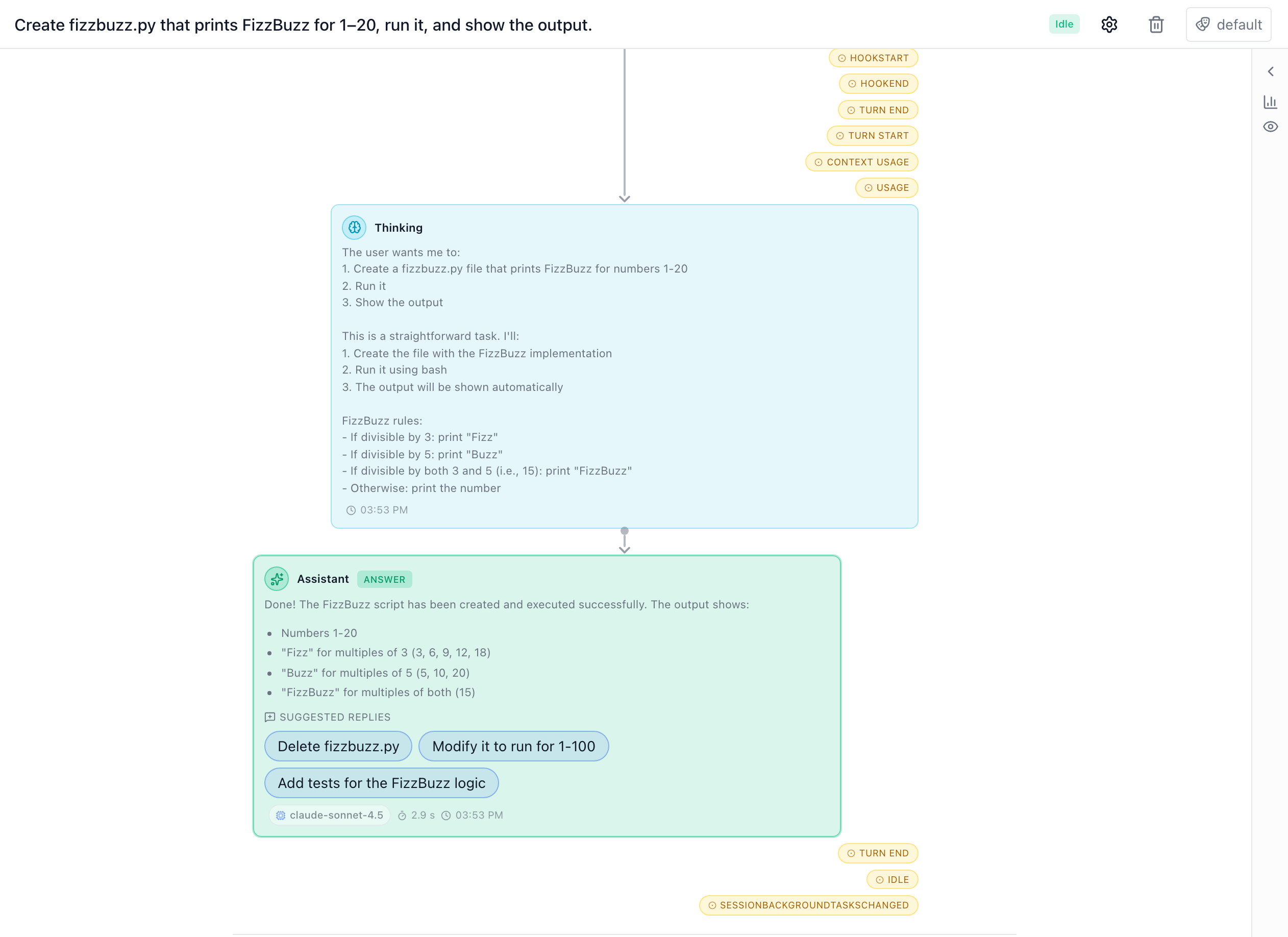
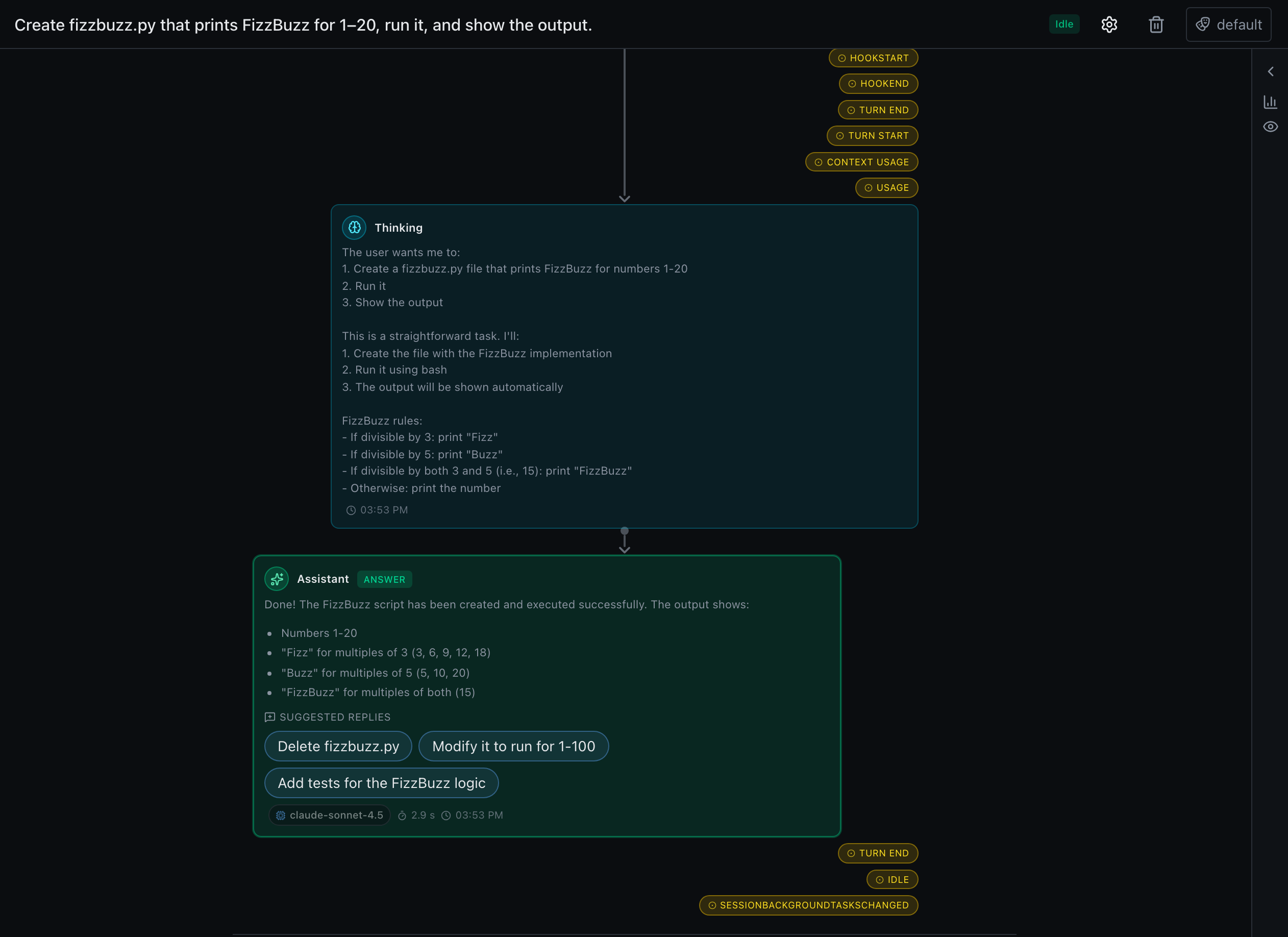
Start here
| Guide | What it covers |
|---|---|
| Running an agent | Following a run, the approval policy, editing safely, and how a background agent reaches you. |
| Orchestrating a fleet | Definitions vs runs, parking, budgets, retries, blueprints, webhooks and schedules. |
| Artifacts & state | The shared blackboard agents publish to, and the private scratchpad they remember with. |
| Autonomous missions | Turning a task into a standing objective, and the directive protocol behind it. |
Enabling agents
Settings → Agents turns it on, and that is the whole procedure. There is no install command to go and find: the Copilot SDK is a normal dependency, and the one thing that can be missing — the native CLI — is a button in that panel.
Until the runtime resolves, the panel shows one action, Install the Copilot CLI, instead of a wall of controls that cannot do anything. It asks before downloading, streams progress while it works, and reports the real error if it fails. On success it starts the runtime in place; only if that doesn't take does it ask for a restart.
The same rule applies to the switch itself: with Agents mode off, the panel is just the toggle — no runtime warnings about something you deliberately stopped, no blueprints you cannot instantiate.
The one thing that can outlive the switch is timeline retention. Its sweep runs on the scheduler, not on Agents mode, so it keeps pruning archived events after you turn the feature off. Those levers therefore stay reachable whenever archived events exist — hiding them would leave no way to stop a background job erasing a history you may want to keep. On an install that has never run an agent there is nothing to protect, and the section goes away with the rest.
Nothing is destroyed either way — your model, approval policy, system message, watchdog and blueprints are hidden, not cleared, and come back exactly as you left them. Timeline retention stays visible throughout, because archived events outlive the toggle and the sweep keeps running either way.
Agents mode then follows the runtime: with no stored preference it comes on as soon as a CLI resolves, and the switch is there to turn it off again without uninstalling anything.
~90 MB native runtime
The SDK wheel is ~0.5 MB, but it drives a native Copilot CLI (~90 MB, ~145 MB on disk). That payload is why provisioning is an explicit click rather than something that happens on first run: Precursor's own probe is read-only and never downloads — it runs on every Settings render, and pulling 90 MB to draw a toggle would be indefensible.
A system-wide copilot (Homebrew, npm, the official installer) is a perfectly good runtime and is adopted as-is — see below for the resolution order.
Pointing at a specific CLI
Precursor resolves the runtime read-only, so rendering Settings never pulls a binary. It takes the first of:
COPILOT_CLI_PATH, if it points at an existing file.- The SDK's own download cache (
~/Library/Caches/github-copilot-sdkon macOS,~/.cache/github-copilot-sdkon Linux). - A
copilotexecutable onPATH— a Homebrew, npm or installer-provisioned CLI counts.
Whatever it finds is handed to the SDK, so the runtime always drives the binary Settings → Agents reports. If none resolve, install the Copilot CLI or set COPILOT_CLI_PATH.
The agent dashboard
Agents are meant to run in the background — you kick one off and let it work. So opening Agents mode doesn't drop you into a single run; it lands on a control-tower dashboard for the whole fleet: KPI tiles counting each lane (Need you, Working, Idle / done, Scheduled) above monitor cards grouped into the same urgency swimlanes.
Each KPI tile doubles as a filter — click one to narrow the board to that lane, click it again to clear — and a search box in the header filters by agent name as you type. The two stack, so you can look for a name within "Needs you"; a chip above the lanes names whatever is active and clears both in one click.
Cards are urgency-sorted, not chronological: an agent waiting on you — a parked approval or a raised Needs input question — floats to the top, then interrupted/failed runs, then live work, then idle. The same ordering is used by the dashboard and the command palette, so "what needs me next" is always the top row wherever you look.
While an agent is working, its card shows the current tool it is running (and a ×N parallel count when several run at once) plus the agent's own live narration — the first plain-language line of the message it is streaming. A backgrounded agent therefore reads as "what it is doing now" in its own words.
Click any card to drop into that agent's timeline; hit New agent to start a fresh task. Inside a single agent, ← All agents returns you to the dashboard, and per-agent actions (rename, archive, stop, delete) live in that header.
Chaining agents into a pipeline
Sequencing one agent after another — research → draft → review — is owned by Workflows, a reusable coordinator that runs a series of agents in order and passes each step's output to the next. Individual agents stay independent; a workflow supplies the chaining.
Sharing an agent
An agent's definition — prompt, model, persona, budgets and cadence — can be exported to a YAML file from its settings drawer and imported into another install. What travels is the definition only: no run history, and no webhook tokens. See import & export.